Deciding when to order bridesmaid dresses is not as simple as counting backward six months and choosing one deadline.
The right timeline depends on how the dresses are made, whether the group needs matching colors, how quickly the retailer ships, the complexity of alterations and whether any bridesmaid expects meaningful body changes before the wedding.
Six to eight months before the wedding is a useful target for many made-to-order bridesmaid collections. It is not a universal rule.
A ready-to-ship dress may need less time. A custom style, international order or heavily altered dress may need more.
At Wedding Dress Style, we build the timeline backward from the day every bridesmaid must have a finished, wearable outfit—not merely from the retailer’s estimated delivery date.
The Short Answer
For a typical U.S. wedding, aim to follow this schedule:
- Eight to nine months before: Discuss budget, fit requirements and wedding style.
- Seven to eight months before: Choose the color, fabric and approved dresses.
- Six to seven months before: Take measurements and place orders.
- Three to four months before: Check every delivery and resolve order problems.
- Six to eight weeks before: Begin alterations.
- Two to three weeks before: Complete the final fitting.
- One week before: Try on the entire outfit and prepare it for travel.
This schedule includes breathing room for exchanges, production delays and alteration appointments.
The specific retailer’s timeline should always take priority. Jenny Yoo currently describes six to eight months as ideal for many bridal-party gowns, while David’s Bridal recommends shopping approximately six months before the wedding to allow time for delivery and alterations.
Nine Months Before: Start With People, Not Products
Before choosing a dress, privately ask each bridesmaid about:
- Her comfortable budget
- Support and coverage requirements
- Preferred dress features
- Accessibility or mobility needs
- Approximate ordering availability
- Expected travel
- Known pregnancy or postpartum considerations
- Any concern she would rather not discuss in a group
This is also the time to decide who will pay for the dress, alterations, shoes and accessories.
Do not ask bridesmaids to begin shopping until these decisions are clear. An early start does not help when everyone is working with different assumptions.
If you have not selected the overall approach yet, begin with our guide on how to choose bridesmaid dresses.
Eight Months Before: Finalize the Dress System
By this point, the bride should decide whether the bridal party will wear:
- One identical dress
- One color and fabric with different styles
- Several controlled shades
- Different fabrics within one palette
- Ready-to-ship dresses
- Made-to-order dresses
- Custom-sized dresses
For a mix-and-match group, finalize the approved choices before anyone purchases. Our guide to mix and match bridesmaid dresses explains how to control colors, fabrics and silhouettes without making the group appear accidental.
Order physical fabric swatches and view them in different lighting. If exact color consistency matters, confirm whether the retailer recommends ordering within the same period or using a specific group-order process.
This is also the right time to contact local alteration professionals.
You do not need a finished dress to ask:
- How far ahead appointments are booked
- How long bridesmaid alterations usually take
- Whether the shop works with the selected fabric
- Whether it handles complex changes
- Whether appointments become limited during prom and wedding season
The first fitting may still be months away, but the seamstress’s calendar can fill before the dress arrives.
Seven Months Before: Create One Final Information Sheet
Bridesmaids should not have to reconstruct the plan from a long group conversation.
Create one message or document containing:
- Designer or retailer
- Exact dress name or approved styles
- Official color name
- Required fabric
- Dress length
- Ordering instructions
- Final ordering deadline
- Expected delivery window
- Return or exchange policy
- Alteration reminder
- Shoe requirements
- Who to contact privately with concerns
Include direct product links. If several styles are approved, identify which bridesmaid has selected each one.
Ask everyone to acknowledge that she has read the information. This is more useful than assuming silence means understanding.
Six to Seven Months Before: Take Current Measurements
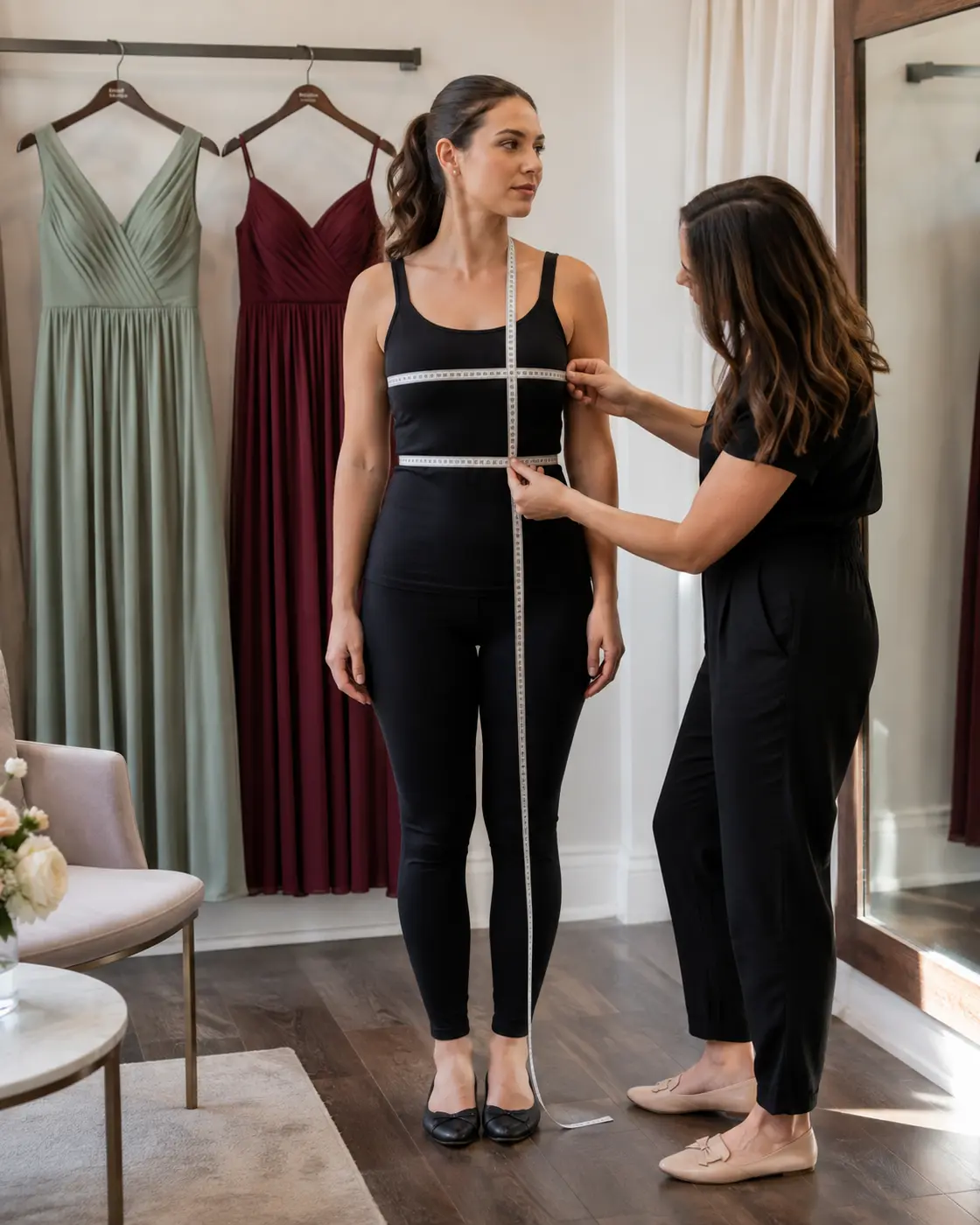
Measurements should be taken close to the ordering date—not borrowed from an old tailoring appointment or estimated from everyday clothing.
Each bridesmaid should measure:
- Full bust
- Natural waist
- Fullest part of the hips
- Hollow to floor when required
- Height
- Heel height if the ordering system requests it
Use the designer’s own instructions and size chart. Bridal and occasion sizes do not necessarily match everyday clothing sizes.
The objective is not to order the smallest possible number. It is to select the size that gives the seamstress enough fabric to create a secure fit.
When bust, waist and hip measurements fall into different sizes, contact the retailer or an experienced tailor before ordering. The safest selection depends on the dress construction and available seam allowance.
Custom sizing may reduce some adjustment needs, but it does not guarantee a completely alteration-free dress. Posture, undergarments, shoe height and individual fit preferences can still affect the result.
Six Months Before: Place the Orders
For many made-to-order collections, this is the central ordering period.
Do not set the deadline for the same day you hope everyone will order. Give bridesmaids a private internal deadline at least one or two weeks earlier.
That creates time to handle:
- Payment problems
- Unavailable sizes
- Out-of-stock styles
- Measurement questions
- Shipping-address mistakes
- A bridesmaid who misunderstood the instructions
Confirm every order individually. Ask for the order number, style, size, color and fabric—not payment information.
A bridesmaid saying “I ordered mine” is reassuring, but it does not reveal that she accidentally selected satin instead of chiffon.
Why the Group Should Order Within the Same Period
When dresses are intended to match, spreading orders across several months can create avoidable risk.
Fabric is produced in batches, and slight color variation may occur between production runs. Retailer policies differ, so ask the selected company whether it offers group ordering or recommends a particular ordering window.
This matters most when everyone is wearing the same shade and fabric.
For a deliberately tonal bridal party, small variation may support the design. For six supposedly identical sage dresses, one noticeably different shade can appear accidental.
Ordering together also makes delivery tracking easier. The bride can identify a group-wide delay earlier rather than discovering the problem through the final bridesmaid’s late order.
What If a Bridesmaid Expects Her Size to Change?
Do not delay the entire bridal party automatically.
First determine what kind of change is expected and how predictable it is.
Pregnancy
Contact the dress company before ordering. Ask about maternity-friendly construction, measurement guidance, extra length, flexible waistlines and recommended ordering procedures.
Empire waists, adjustable features and less rigid skirts may provide more flexibility, but no single style works for every pregnancy.
Arrange an alteration professional early and schedule the final fitting relatively close to the wedding while still leaving time for changes.
Postpartum Changes
Do not pressure a postpartum bridesmaid to predict her exact future measurements.
Choose adaptable construction, avoid rigid expectations and reserve money and time for later alterations. Comfort and support requirements may change in ways that cannot be planned precisely several months ahead.
Planned Weight Changes
Order according to current measurements unless the retailer or tailor gives different guidance.
A seamstress can often take in a dress, but the amount depends on its seams, embellishment and construction. Ordering a dramatically different size based on a hoped-for measurement creates unnecessary risk.
The respectful question is not, “What size will you be by the wedding?”
It is, “What ordering and alteration plan gives you the most flexibility?”
Four Months Before: Track Every Dress
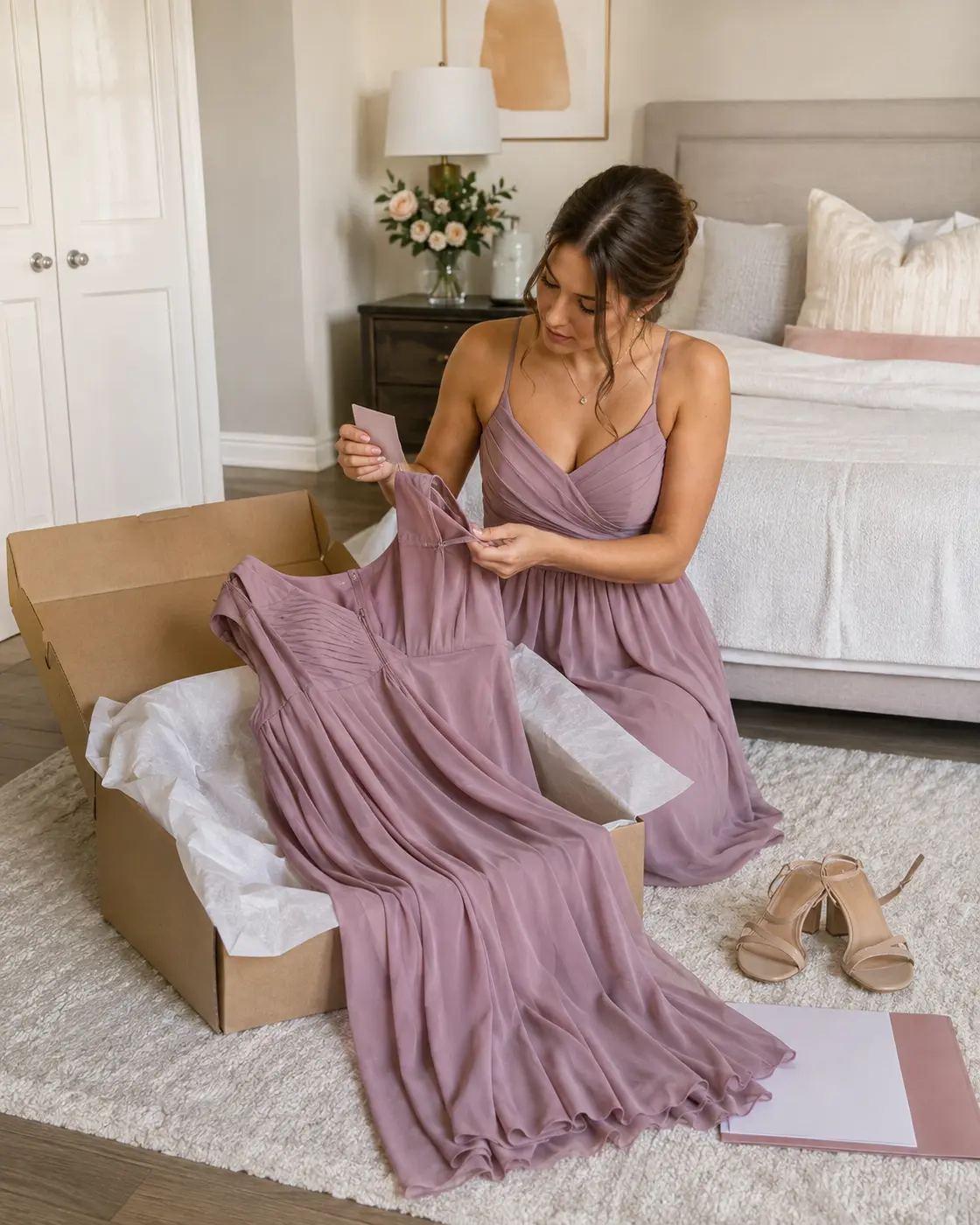
Create a simple list with four statuses:
- Ordered
- Shipped
- Delivered
- Inspected
Do not stop tracking at “delivered.”
Each bridesmaid should open the package promptly and verify:
- Correct style
- Correct size
- Correct color
- Correct fabric
- No stains or damage
- Working zipper or closure
- Included straps or accessories
- Adequate fabric for expected alterations
She should then try on the dress with suitable undergarments.
A dress should not remain sealed until the alteration appointment. Return windows may close while the problem sits unnoticed in a closet.
Three Months Before: Resolve Problems, Not Perfect the Fit
At three months, focus on major issues:
- The wrong dress arrived
- The color is incorrect
- The dress is damaged
- The size cannot reasonably be altered
- A replacement must be ordered
- The original alteration professional is unavailable
This is not necessarily the moment for final tailoring, particularly if a person expects her measurements to change. It is the moment to make sure every bridesmaid has a viable dress and a confirmed fitting plan.
If a replacement is necessary, contact the retailer immediately and ask for realistic options rather than assuming an identical new dress will arrive in time.
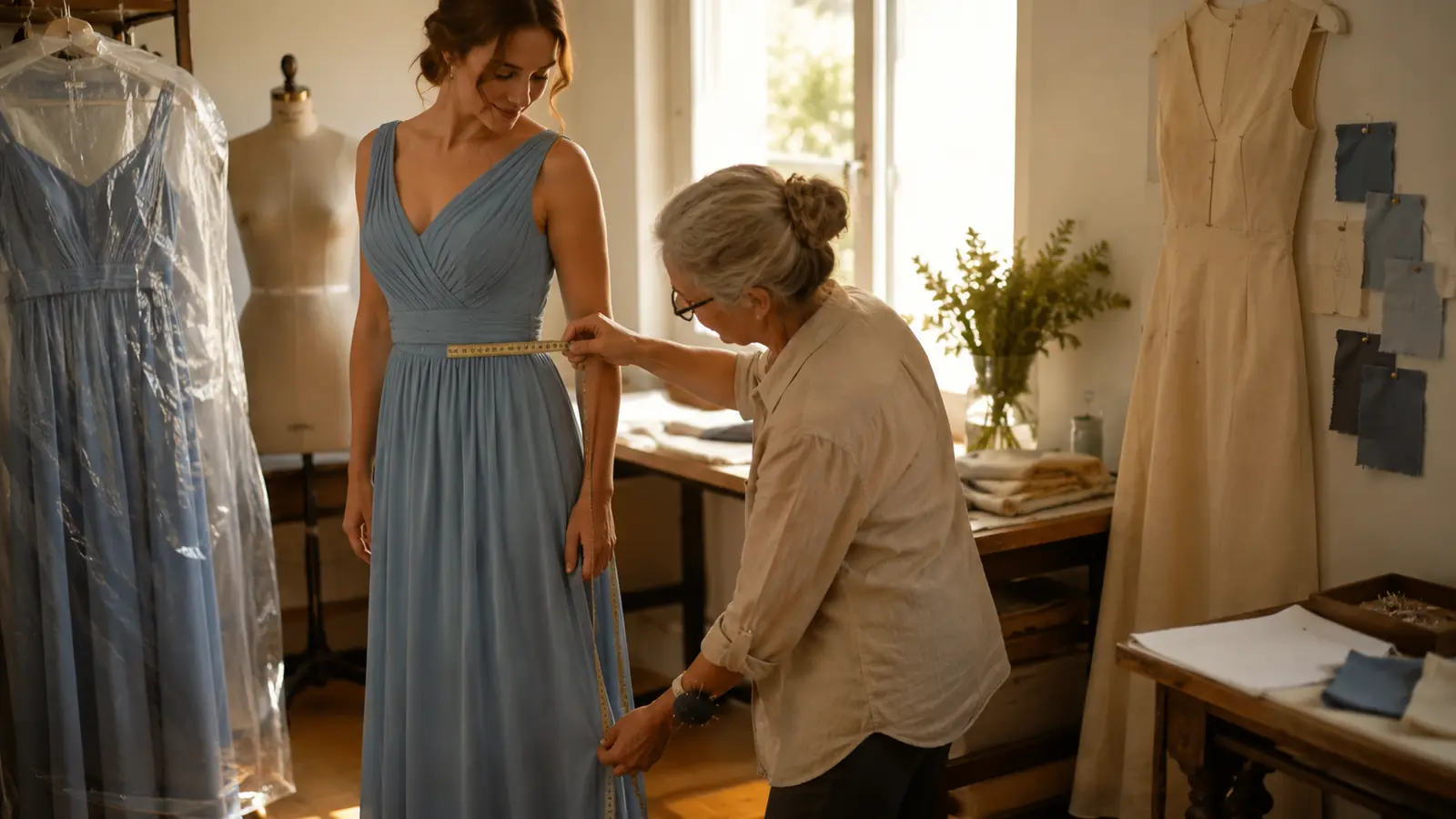
Six to Eight Weeks Before: Begin Alterations
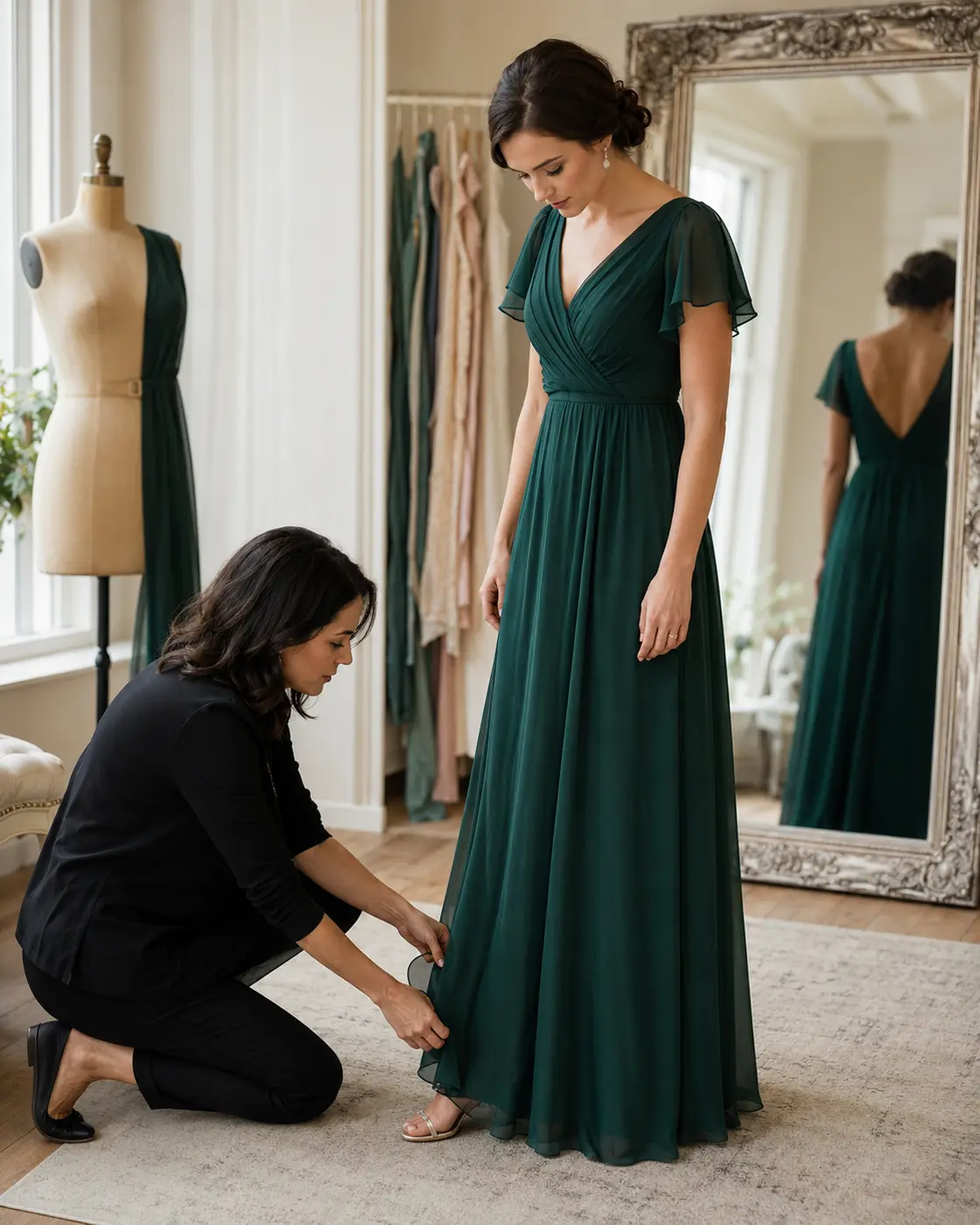
A practical alterations window begins approximately six to eight weeks before the wedding for many bridesmaid dresses.
Azazie states that alterations commonly take about two to four weeks and recommends a first fitting around four to six weeks before the wedding. Kennedy Blue presents a timeline beginning approximately eight weeks before, followed by fittings at four to six weeks and again around two weeks.
Local availability can be more important than the theoretical sewing time. A seamstress may need only two weeks to complete the work but have no open appointment for the next month.
Common alterations include:
- Hemming
- Shortening straps
- Adjusting sleeves
- Taking in the waist or bust
- Reshaping side seams
- Securing a neckline
- Closing or adjusting a slit
- Adding cups or support
- Correcting dress length for the selected shoes
Bring the actual shoes and undergarments to the fitting. A hem measured in flats will not work correctly if the bridesmaid later changes to heels.
Two to Three Weeks Before: Complete the Final Fitting
At the final fitting, the bridesmaid should do more than stand in front of the mirror.
She should:
- Sit
- Walk
- Raise both arms
- Bend forward
- Take a long step
- Turn around
- Practice holding a bouquet
- Check the neckline from several angles
- Confirm the hem with her wedding shoes
Look for new problems created by the alterations. Shortened straps may improve the neckline but make the armholes uncomfortable. Taking in the waist may change how the zipper closes when seated.
The dress is finished only when it works during movement.
One Week Before: Test the Complete Outfit
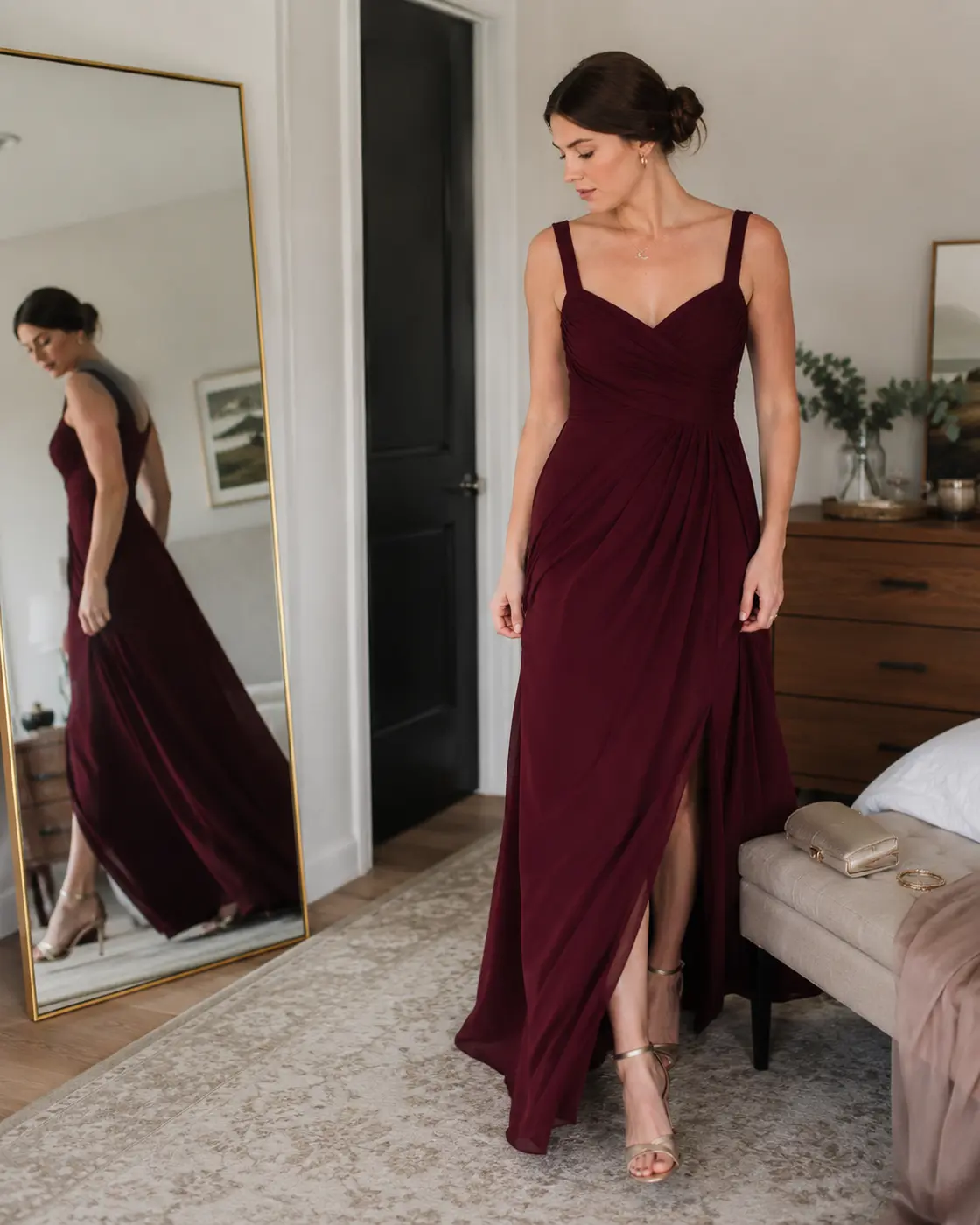
The final week is not the right time to discover that the bra shows above the back or the shoes catch the hem.
Every bridesmaid should try on:
- The altered dress
- Wedding-day undergarments
- Shoes
- Jewelry
- Any wrap, shawl or jacket
- Required hair accessories
Photograph the outfit from the front, side and back.
Then check practical details:
- Can she walk safely?
- Does the dress remain secure?
- Are the shoes broken in?
- Does the jewelry catch on the fabric?
- Does anything need steaming?
- How will the dress be transported?
Small corrections are still possible. Major redesigns should no longer be part of the plan.
What If the Wedding Is Less Than Six Months Away?
A shorter timeline does not mean the bridal party cannot look coordinated. It means the shopping strategy must change.
Prioritize:
- Ready-to-ship dresses
- Retailers showing real inventory
- Straightforward silhouettes
- Fabrics that are easier to alter
- Flexible color palettes
- Reliable return policies
- Local stores with take-home inventory
Before purchasing, call an alteration professional and confirm availability.
Do not choose a made-to-order dress simply because the estimated arrival date falls before the wedding. You still need time for inspection, possible exchange and alterations.
With less than three months, consider selecting dresses from one ready-to-ship collection or allowing coordinated formal dresses rather than requiring one exact style that may not be available in every size.
What If One Bridesmaid Orders Late?
First, determine the real situation without turning it into a group conflict.
Ask:
- Has the order been placed?
- Is the chosen dress still available?
- What is the current delivery estimate?
- Is expedited production or shipping offered?
- Is a ready-to-ship version available?
- Can another approved dress maintain the palette?
- Does a local store have a suitable option?
Do not make the entire bridal party reorder unless matching is absolutely essential and no alternative exists.
For a mix-and-match group, the solution may be another dress in an approved shade. For identical dresses, contact the retailer and ask about inventory, cancellations or floor samples.
The objective is to solve the visual and practical problem—not punish the person who ordered late.
The Wedding Dress Style Deadline Test
Before announcing the ordering deadline, answer five questions.
1. Production
How long does the selected retailer currently require to make or prepare the dress?
2. Delivery
How much time is needed for shipping, including possible delays?
3. Correction
Is there enough time to exchange a wrong, damaged or unsuitable dress?
4. Alterations
Has each bridesmaid identified an alteration professional and checked availability?
5. Final Fit
Will the alterations finish early enough for one complete-outfit test?
If your schedule contains no time between these stages, the dresses are already being ordered too late.
A Timeline That Looks Safe but Is Not
Imagine a September wedding with dresses expected to arrive in early August.
On paper, the group has one month remaining.
Then one dress arrives in the wrong color. Another bridesmaid needs the bodice taken in and a multilayer chiffon hem shortened. Local seamstresses are busy with summer weddings, and the bridesmaid still has not purchased her shoes.
The problem is not that one month is never enough to sew a hem.
The problem is that the plan allowed only enough time for everything to go correctly.
A realistic timeline includes recovery time.
That extra month is not wasted time. It is what protects the group from ordinary mistakes, delays and changes.
Our Final Perspective
The best time to order bridesmaid dresses is early enough to preserve choices, but close enough to use meaningful current measurements.
For many made-to-order collections, six to eight months before the wedding is a strong target. The exact deadline should come from the retailer’s production schedule, shipping estimate, return policy and the availability of a trusted alteration professional.
Choose the dresses first. Measure carefully. Order as a coordinated group. Inspect every delivery immediately. Begin alterations with enough time for more than one fitting.
Most importantly, do not build a timeline that works only if nothing goes wrong.
A calm bridesmaid-dress plan is not the one with the earliest possible order date.
It is the one with room to recover.