A-Line vs. Fit-and-Flare Wedding Dresses: What You Notice in the Fitting Room
Choosing between an A-line and a fit-and-flare wedding dress can feel surprisingly difficult. One gives you softness and freedom; the other creates definition and drama. Both may look beautiful in photographs, yet they can feel completely different once you sit down, walk across the room or imagine wearing the dress for eight hours.
The most useful question is not, “Which silhouette is best for my body type?”
It is: “How do I want my wedding dress to work with my body throughout the day?”
At Wedding Dress Style, we compare these silhouettes through four things brides actually experience: the release point, movement, support and fabric.
The Difference Between A-Line and Fit-and-Flare
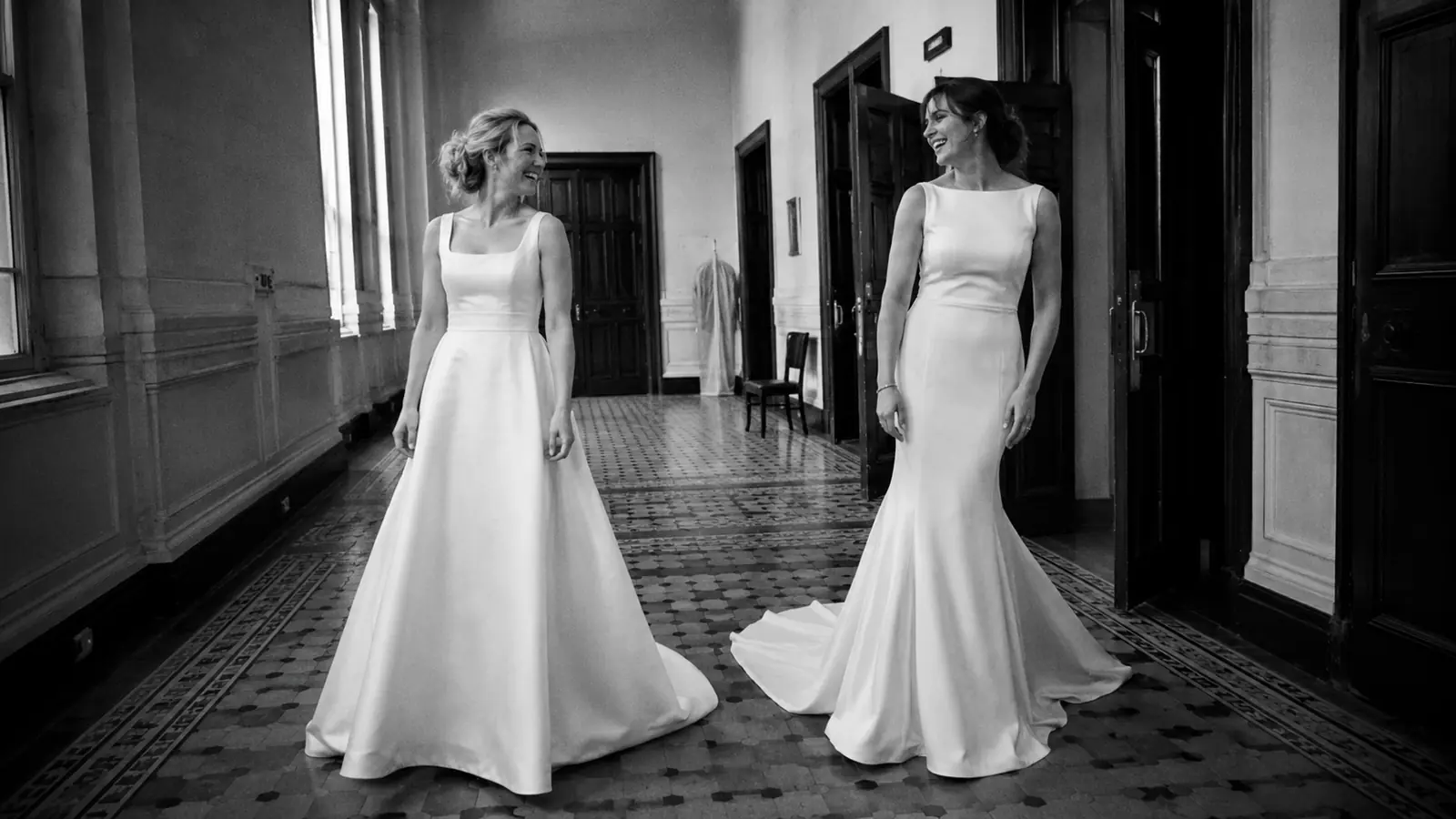
An A-line wedding dress is generally fitted through the bodice and waist before gradually widening toward the floor. Its outline resembles the letter “A.”
A fit-and-flare gown follows the body more closely through the waist and hips before widening farther down. The precise point where the skirt begins to open varies considerably between dresses.
That last detail matters.
Two gowns can both be labeled “fit-and-flare” while one releases just below the hips and another remains fitted closer to the thighs. They will not create the same proportions or allow the same movement.
The label identifies the general family of the dress. It does not tell you exactly how that particular gown will feel.
Start With the Release Point
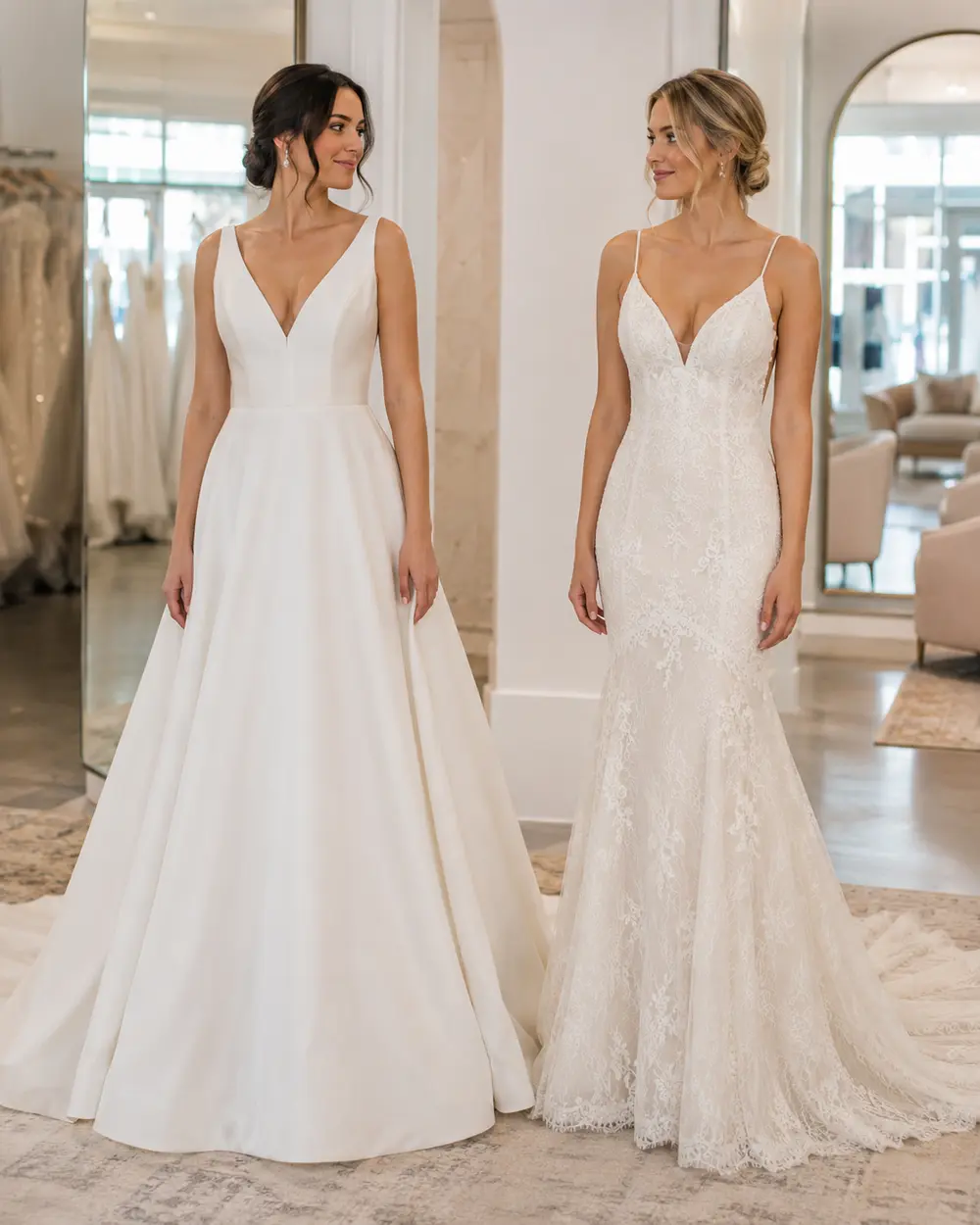
The release point is where the skirt stops following your body closely and begins to flare outward.
This is the detail we would examine first when comparing the two silhouettes.
On an A-line dress, the release usually begins around the waist. The skirt moves away from the hips, creating open space beneath it.
On a fit-and-flare dress, the release begins lower. The fabric continues following the hips and possibly part of the thighs before opening into the skirt.
Instead of only looking at your waist in the mirror, turn sideways and locate that point. Then ask:
- Does the fabric pull across my hips?
- Can I take a natural step?
- Does the skirt open where I want it to?
- Does the dress maintain its shape when I move?
- Am I comfortable with how closely it follows my body?
This tells you more than a traditional body-shape chart ever could.
What an A-Line Dress Feels Like
An A-line often creates an immediate sense of ease. Because the skirt moves away from the body at the waist, there is usually more room around the hips and legs.
That can make walking, sitting and climbing stairs feel more natural. It can also make the gown easier to wear during an outdoor ceremony or a reception where you plan to dance.
But “A-line” does not automatically mean light.
A gown made with several layers of tulle, a structured underskirt or heavy embellishment can still feel substantial. Meanwhile, a chiffon A-line may feel soft and fluid enough to move with every step.
This is why you should evaluate the actual dress rather than relying on its silhouette name.
An A-line may suit you when:
- You want space around your hips and legs.
- You prefer a defined waist without a body-hugging skirt.
- You expect to walk across grass, sand or uneven ground.
- You want a romantic shape without full ball-gown volume.
- You do not want to think about holding your stomach in all day.
The last point is not about hiding your body. It is about deciding how much attention you want to give the dress while wearing it.
A wedding gown should not require constant monitoring.
What a Fit-and-Flare Dress Feels Like
A well-fitted fit-and-flare gown can feel remarkably secure. Instead of hanging primarily from the shoulders, a structured version may feel supported through several points of the body.
It also creates a more defined outline. If you love the shape from the front, do not stop there. Look at it from the side and back, because those views reveal where the seams, flare and train are doing their work.
Fit-and-flare is sometimes confused with mermaid. The boundaries between bridal labels are not always consistent, but a traditional mermaid dress generally remains fitted lower before opening more dramatically. A fit-and-flare commonly releases earlier and more softly.
A fit-and-flare may suit you when:
- You enjoy a clearly defined waist and hip line.
- You want the dress to feel sculpted rather than flowing.
- You love the silhouette from every viewing angle.
- You are comfortable with more fabric contact around your hips.
- The gown lets you move without forcing you to shorten your steps.
The final point is essential. A fitted dress should follow your movement, not negotiate against it.
The Wedding Dress Style Movement Test
Bridal mirrors are designed for stillness. Weddings are not.
Before deciding between an A-line and fit-and-flare wedding dress, perform this short movement test in both gowns.
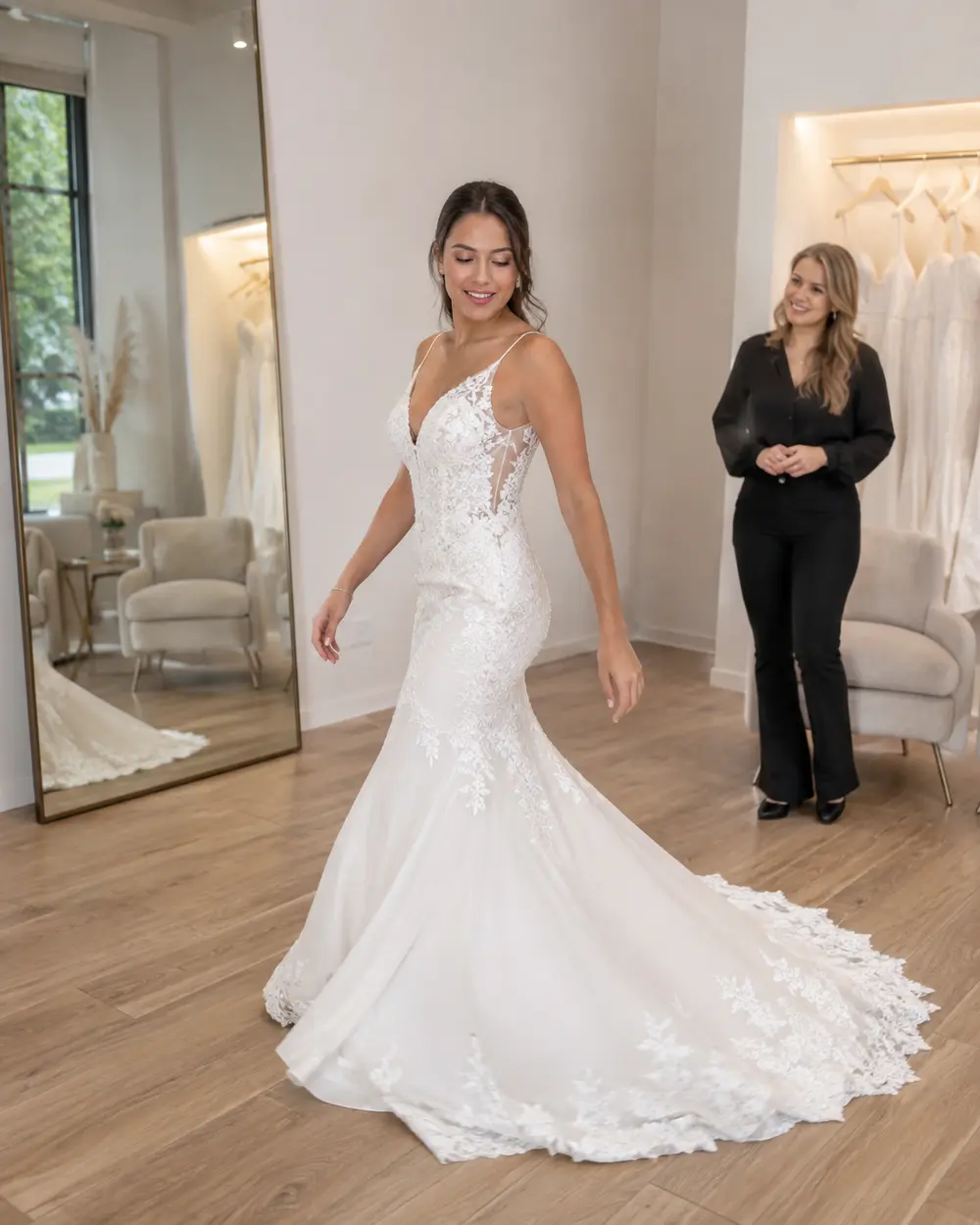
1. Take ten normal steps
Do not use the careful, shortened walk you naturally adopt around a sample dress. Walk as normally as the gown allows.
Notice whether the skirt follows you or restricts the length of your step.
2. Sit for at least one minute
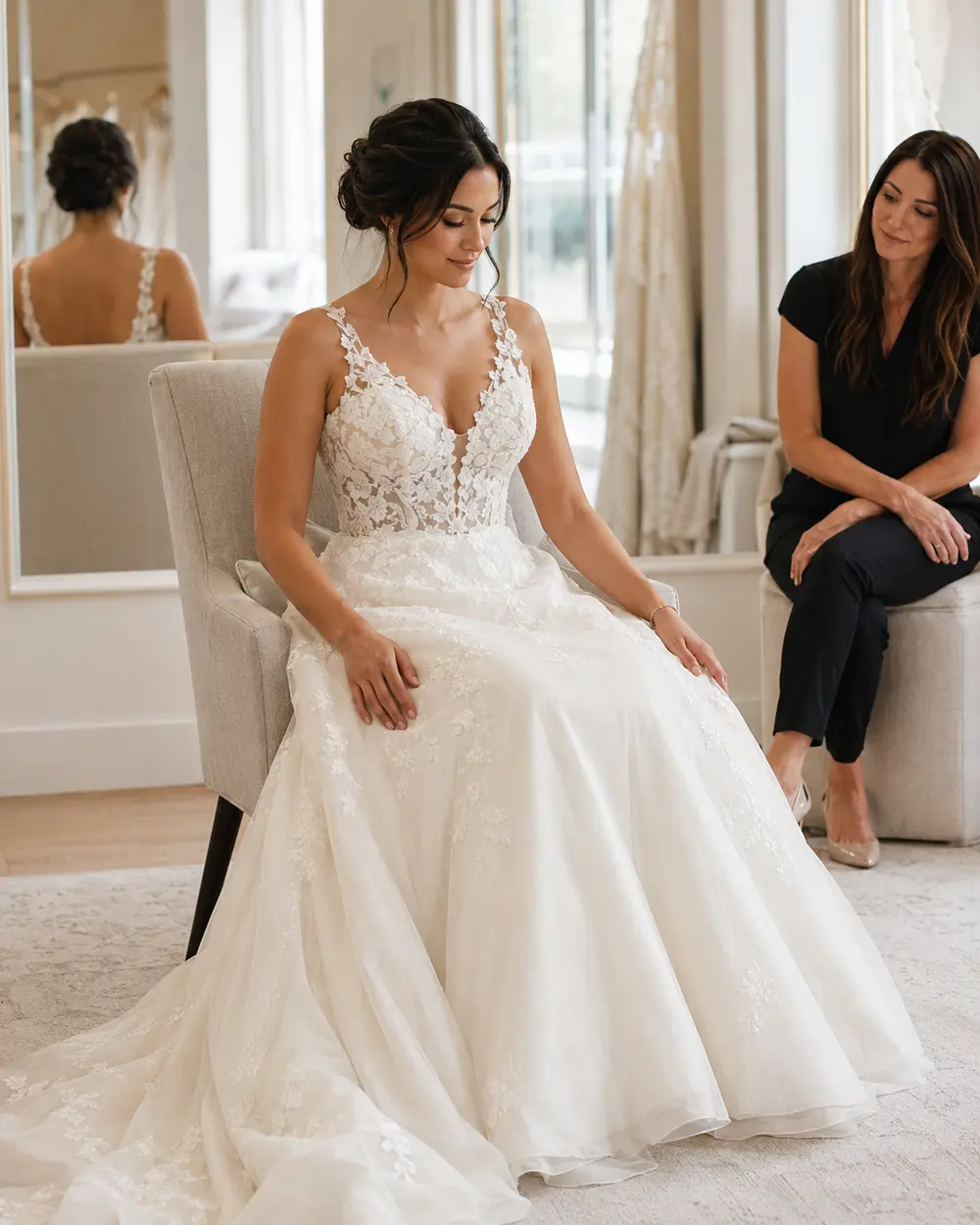
A quick bend toward a chair is not enough. Sit fully and allow your body to relax.
Check the pressure around your waist, ribs and hips. A dress that feels secure while standing can feel completely different when seated.
3. Raise both arms
Pretend you are hugging someone, dancing or reaching to adjust your hair.
Watch whether the bodice rises and stays raised. If it does, alterations may improve the fit, but you should discuss this with the seamstress before ordering.
4. Turn without arranging the skirt
Rotate naturally and look behind you. Observe how the skirt and train settle without a stylist immediately correcting them.
5. Take a deep breath
It sounds simple, but it reveals whether you are comfortably supported or merely compressed.
Complete the same test in both silhouettes. The difference may be more useful than another twenty minutes in front of the mirror.
Fabric Can Reverse Your Expectations
Silhouette is only half the decision. Fabric determines whether that silhouette feels soft, architectural, forgiving or restrictive.
A structured satin A-line can hold a clean, formal shape. A tulle A-line can create air and movement. Chiffon may fall more closely against the body even when the dress is technically A-line.
In a fit-and-flare gown, stretch crepe may allow easier movement than a heavily constructed fabric. Lace appliqués, boning, lining and seam placement can also change how flexible the dress feels.
This creates a fitting-room surprise: a flexible fit-and-flare can occasionally feel easier to move in than a heavy, layered A-line.
Do not compare silhouette against silhouette alone. Compare the complete construction of each gown.
Consider the Setting, Not Just the Style
Imagine the actual surfaces and spaces of your wedding.
For a church ceremony followed by an indoor reception, either silhouette may work beautifully. For a beach, garden or mountaintop ceremony, an A-line may offer easier movement—but fabric weight and train length still matter.
For a formal ballroom wedding, a structured fit-and-flare can create a striking entrance without the width of a ball gown. However, you should also consider how the train will be bustled for the reception.
Ask yourself:
- How far will I walk?
- Will I use stairs?
- Will I sit through a long ceremony or dinner?
- Will the ground be smooth, grassy or sandy?
- How much dancing am I realistically planning?
- Will I have help arranging or bustling the train?
Your venue does not choose your dress, but it exposes which inconveniences you are willing—or unwilling—to accept.
Think About Alterations Before Ordering
Alterations refine a wedding dress; they do not turn it into a different piece of engineering.
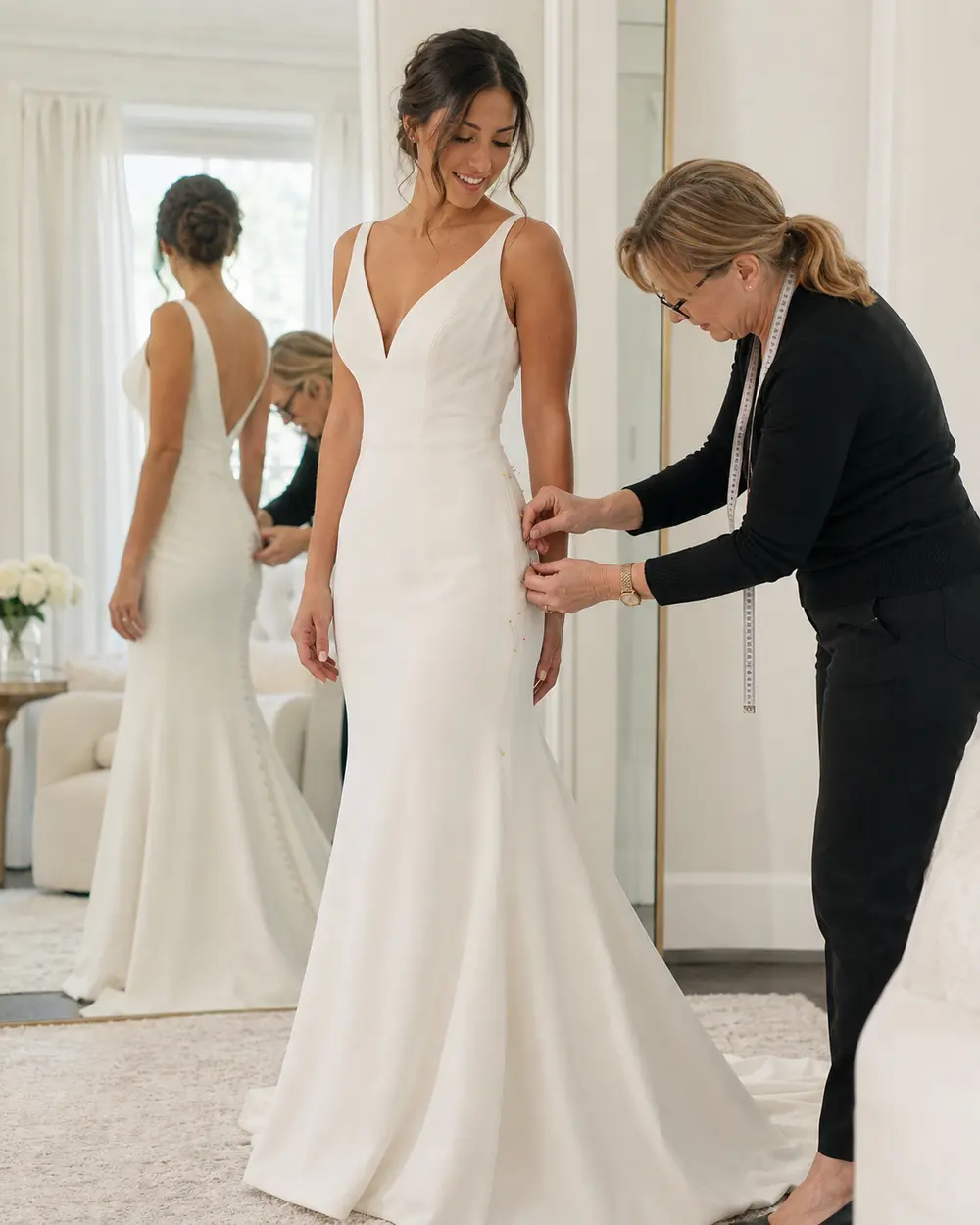
An A-line is generally less dependent on an exact hip fit because the skirt releases earlier. The bodice and waist still require careful fitting, but normal fluctuations around the lower body may have less effect on how the skirt sits.
A fit-and-flare usually depends more closely on the relationship between the waist, hips and release point. Small adjustments can affect the balance of the entire silhouette.
Before ordering a fitted gown, ask:
- Which measurement determines the size we should order?
- Where should this dress release on my body?
- Can the hip or thigh area be adjusted?
- Will altering the bodice affect the placement of lace or beading?
- What bustle works with this train?
- What changes are included in the estimated alteration cost?
Do not treat alterations as a detail to solve later. They are part of the dress decision.
The Photograph Test
Take photos and short videos in both silhouettes from the front, side and back—if the boutique permits it.
Then look at them later, away from the boutique lighting and appointment excitement.
Do not immediately ask which dress makes you look thinner. Ask:
- In which dress does my posture look natural?
- Which one makes me look comfortable rather than carefully posed?
- Which silhouette still feels like my personal style?
- Which dress makes me notice myself before I notice the garment?
- Can I imagine seeing these photographs in ten years?
A dramatic fitted silhouette may win the first photograph, while the quieter A-line may continue feeling like you after the appointment. The opposite can also happen.
Give yourself enough distance to discover which reaction lasts.
A-Line vs. Fit-and-Flare: A Practical Comparison
Choose an A-line if you value:
- More room through the hips and legs
- Easier walking and sitting
- A soft, balanced silhouette
- Less dependence on an exact hip measurement
- Movement for outdoor settings or active receptions
Choose a fit-and-flare if you value:
- Strong waist and hip definition
- A sculpted, body-following shape
- More visual drama through the side and back
- A narrower skirt before the flare
- The secure feeling of a closely fitted gown
Neither list is a rule. A particular fabric, bodice or construction can change the experience completely.
What If You Love Both?
Do not force yourself to declare loyalty to a silhouette before you have chosen a dress.
If you love an A-line for its movement but prefer the definition of a fit-and-flare, try gowns that sit between the two categories. Look for a slimmer A-line, a soft fit-and-flare or a gown with a dropped waist and less restrictive skirt.
You can also ask the stylist to bring two dresses that create a similar mood using different silhouettes. Comparing a romantic lace A-line to a minimalist crepe fit-and-flare may confuse the decision because you are judging both shape and style at once.
A better comparison uses gowns with similar necklines, fabrics or levels of embellishment. That allows you to feel what the silhouette itself is changing.
If you are still exploring all the major shapes, read our guide on how to choose the right wedding dress silhouette before your next appointment.
Our Final Perspective
An A-line gives the body space earlier. A fit-and-flare stays in conversation with the body longer.
That is the clearest difference.
One is not automatically more flattering, more bridal or more comfortable. The right choice depends on how the individual dress releases, how its fabric responds and how you want to move through your wedding day.
Try both. Walk farther than the mirror. Sit longer than a few seconds. Raise your arms, turn around and breathe normally.
Then choose the dress that lets you experience your wedding—not the one that requires you to perform for it.